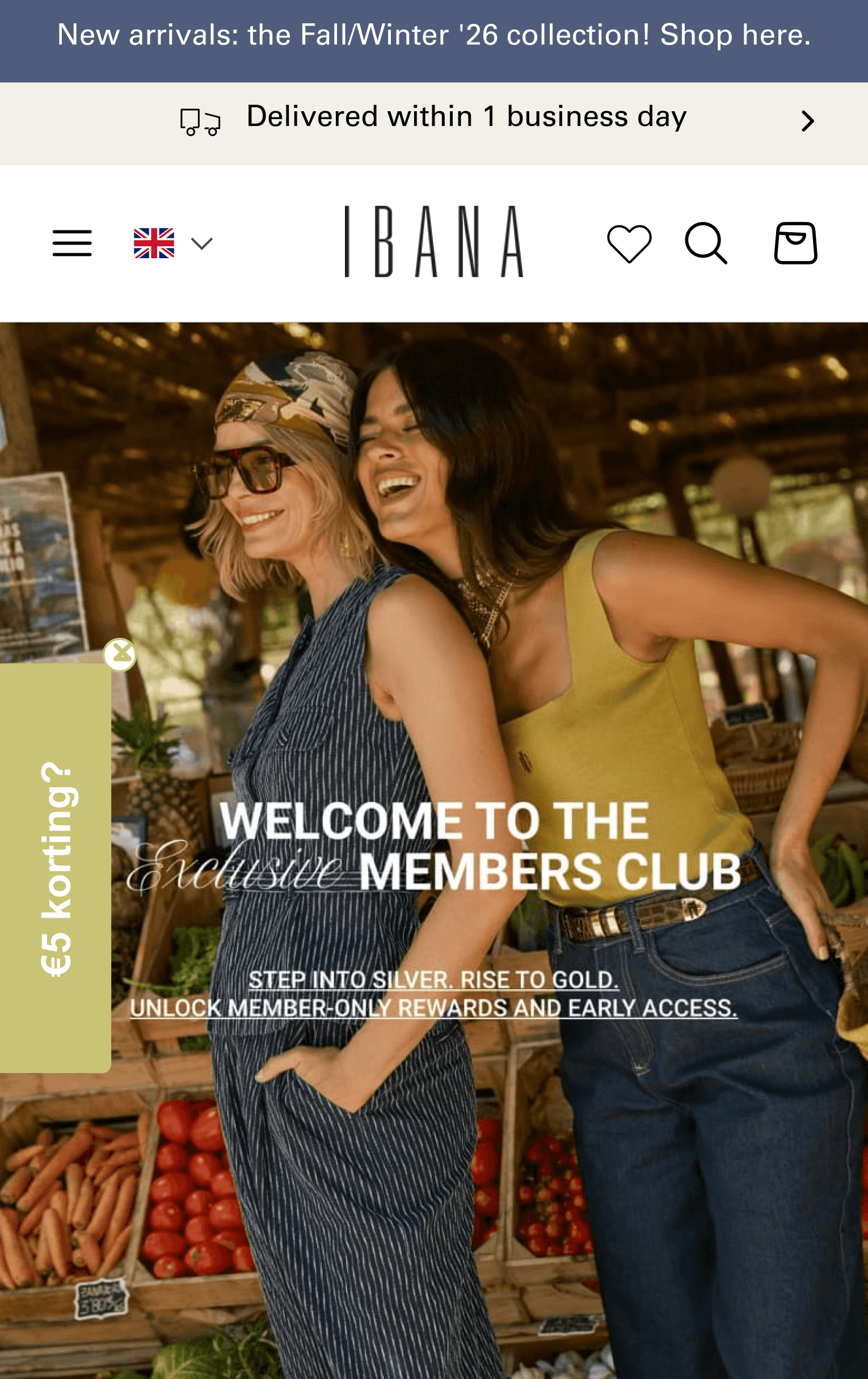


Ibana sells leather jackets, dresses, and knitwear across three countries, and the Members Club ties every point directly to being logged in; guest checkouts earn nothing, which is as much a business decision as a loyalty one.
The Problem This Blueprint Solves: Turning Anonymous Shoppers Into Known Customers
A retailer operating across three countries has every incentive to know who’s actually buying, not just process anonymous guest orders. A loyalty program that only pays out to logged-in customers gives shoppers a direct, tangible reason to create an account instead of checking out as a guest.
The Blueprint: Three Layers of Loyalty
Layer 1: Transactional Loyalty
Membership is free and automatic on account creation; existing newsletter subscribers are enrolled automatically too. Silver, the entry tier, earns 1 point per €1 spent, but only when logged in; a guest checkout earns nothing at all.
Layer 2: Behavioral Loyalty
Gold members earn 1.5 points per €1, plus free returns and double points days, both tiers get. The account-only earning rule reinforces itself here: the more a customer relies on their account (rather than checking out as a guest), the faster they climb.
Layer 3: Emotional Loyalty
Both tiers get a birthday gift, scaled by status (€25 at Silver, €35 at Gold), plus Gold-exclusive early access to sales and new collections. It’s a modest emotional layer, but the birthday-gift-at-every-tier approach (also seen in Le Smash’s case) keeps the entry tier from feeling like an afterthought.


Making the Login Itself the Reward Trigger
The most exportable idea in this case isn’t the tier structure, it’s the rule underneath it: points only post when a customer is logged in. That’s a quiet but effective way to convert guest checkouts into accounts without ever mentioning “please create an account”; the incentive does the persuading on its own.
How It Works
Join free: create an account (existing newsletter subscribers are enrolled automatically)
Log in and shop: 1 point per €1 at Silver, 1.5 at Gold; guest checkouts earn nothing
Climb to Gold for free returns, double points days, and early sale access

What This Blueprint Achieves
By tying every point strictly to being logged in, Ibana turns its loyalty program into an account-creation tool as much as a rewards scheme, a subtle mechanic worth calling out explicitly to clients who care about first-party customer data across multiple markets.
The Takeaway
Ibana is a useful example that a loyalty program’s mechanics can serve a second business goal beyond retention. Tying points to login status is a small rule with an outsized effect: it makes “create an account” a customer’s own idea, not a checkout-page ask.