Ozone Coffee roasts and serves specialty coffee across several London locations, while also running a full e-commerce store selling beans, brewing equipment, and subscriptions. That dual identity of both café and online retailer is exactly what makes loyalty a harder problem to solve than for a single-channel business, and exactly what the Ozone Rewards Club blueprint is designed to address.
The Problem This Blueprint Solves: One Brand, Two Very Different Buying Habits
A customer grabbing a flat white on their way to work and a customer restocking beans online don't behave the same way. A loyalty program for a business like this can't force customers to pick a channel, and it can't leave the business managing two disconnected sets of customer data. The Ozone Rewards Club is built around solving exactly that issue, making sure that customers don't lose out between channels and that Ozone gets the most from their loyalty community.
The Blueprint: Three Layers of Loyalty
Rather than treating loyalty as a single discount mechanic, the Ozone Rewards Club is built in layers, each doing a different job. This layered approach is a useful way to think about any loyalty program, and it's clearly visible in how Ozone Coffee has structured theirs.
Layer 1: Transactional Loyalty
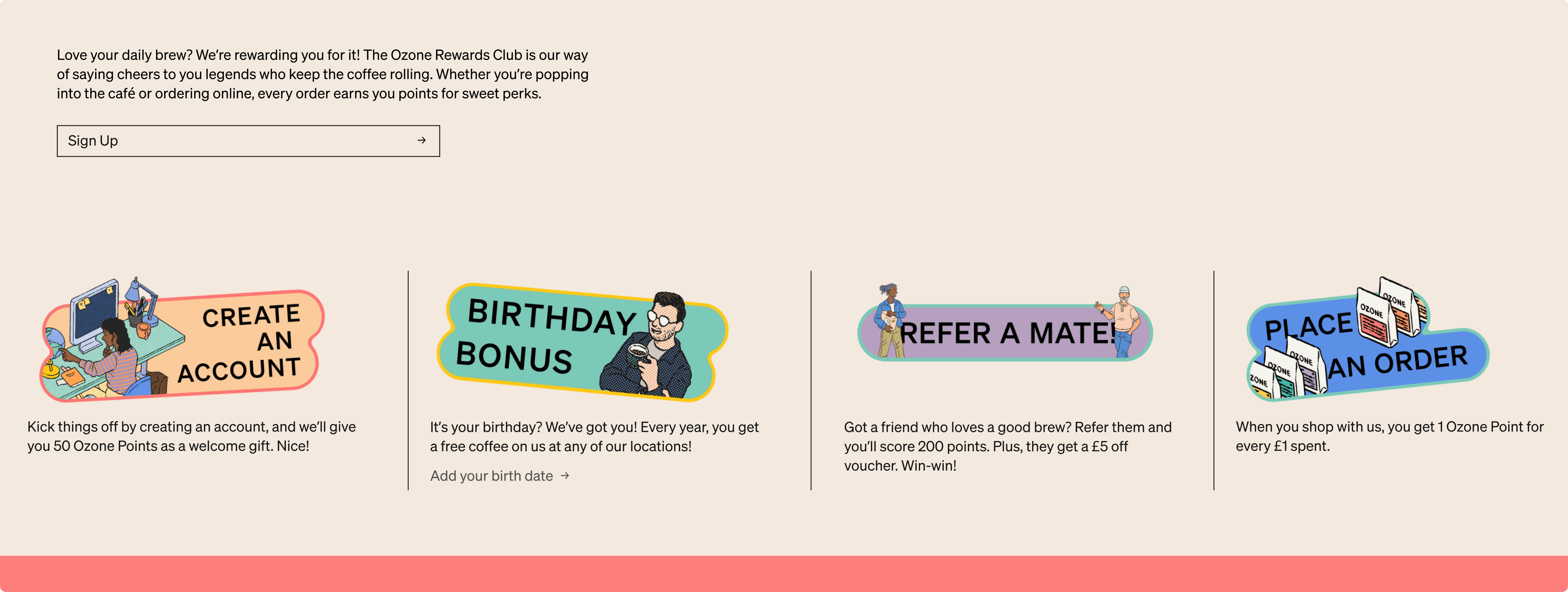
The first layer has to be frictionless if you want to maximize loyalty participation. It rewards people simply for showing up and starts earning trust immediately. Ozone gives new members 50 points just for creating an account, and every purchase earns 1 point per £1 spent, whether that's in a café or on the website. There's no threshold to hit and nothing to figure out. The reward is immediate, and the risk to the customer is zero.
Layer 2: Behavioral Loyalty
Once someone is in the program, the second layer is about making the earning itself rewarding. Ozone's points can be redeemed for tiered discounts (150 points for 5% off, 300 points for 10%, 600 points for 25%) or for specific free items, like a drink for 100 points or a side for 200 points. This is the layer that turns a single purchase into an ongoing habit: customers can see exactly what they're working toward, and every purchase visibly moves them closer to it.
Layer 3: Emotional Loyalty
The third layer is where a points system stops feeling transactional and starts feeling personal. Ozone does this with a birthday reward (a free coffee at any location once a customer has shared their birthday) and with a referral program that rewards both sides: 200 points for the member who refers a friend, and a £5 voucher for the friend who joins. Neither of these is really about the discount. They're small signals that the brand knows its customers and wants its best customers bringing in more people like them.


Unified Everywhere: One System, Every Channel
The detail that makes Ozone's program genuinely powerful isn't any single reward. It's that none of it is channel-specific. Points earned in a café can be spent online. Points earned online can be spent in any of Ozone's locations. There's one customer profile behind it, not two disconnected ledgers for "in-store" and "digital."
This is also where physical and digital gift cards matter. A gift card bought online and one bought in-store should draw from, and top up, the exact same balance, so a customer never has to think about which version of the brand they're dealing with. For a business like Ozone, where the café and the ecommerce store are equally important revenue channels, this unification isn't a nice-to-have. It's the difference between one loyal customer and two separate, half-known ones.
Loyalty Placements: Bringing the Reward to the Decision Moment
A loyalty program is only as effective as how visible it is at the moment someone is deciding whether to buy. This is where loyalty placements come in: small, purpose-built spots across the website where the program shows up in context, instead of being tucked away on a separate rewards page.
Ozone does this on their Shopify store by surfacing the points a customer will earn directly on the product page, right next to the item they're considering. Instead of asking customers to do the maths on their own, or to remember that purchases earn points at all, the reward is shown exactly where the decision is being made. That small nudge (seeing "you'll earn X points for this" while browsing beans or equipment) turns the loyalty program from a background feature into an active part of the shopping experience, and it's a detail that costs little to implement but noticeably increases how often people actually pay attention to the program.
This is a placement any ecommerce brand running a Leat-powered program can add: product pages, cart, and checkout are the highest-attention moments on the entire site, and each one is an opportunity to remind a customer that this purchase is doing more than filling their basket.
Sign up: takes about a minute, and comes with 50 points on the house
Earn points: 1 point per £1, automatically, in cafés, eateries, or online
Redeem rewards: wherever you like, a flat white at your local café, or beans delivered to your door
What This Blueprint Achieves
Structured this way, the Ozone Rewards Club turns what would otherwise be two separate customer relationships (café regulars and online shoppers) into one continuous one, with a single loyalty identity that follows the customer everywhere they choose to buy. [Ask the client for concrete figures here (member count, repeat purchase rate, redemption rate) to strengthen this section with hard numbers.]
The Takeaway
The Ozone Rewards Club is a clear example of what a layered approach to loyalty looks like in practice: an effortless first reward, an ongoing incentive to keep earning, and a handful of emotional touches that turn customers into advocates, all running on a single system that doesn't care whether the customer walked in or logged in. It's a blueprint any café, restaurant, or hybrid retail-and-ecommerce business can adapt.